
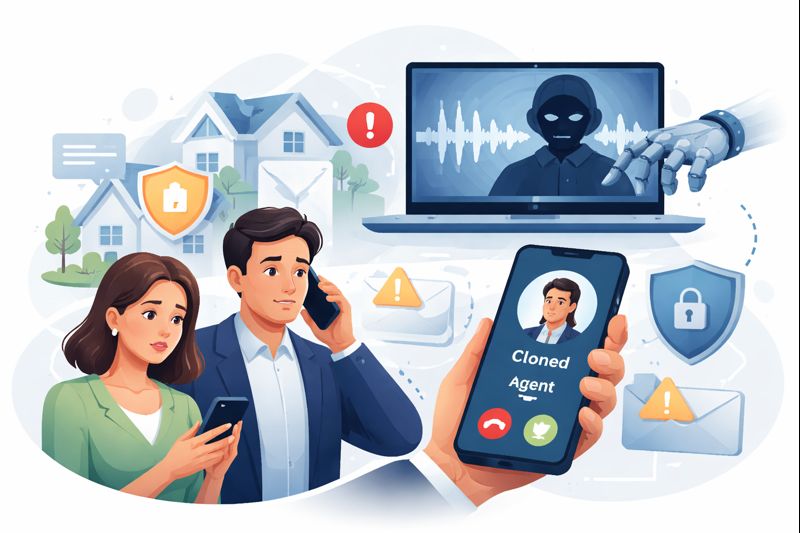
AI voice cloning means bad actors can record a few seconds of someone’s voice, feed it into an AI model, and generate eerily accurate fake audio that sounds like the real person. All they need is a clip from a social media video, voicemail, podcast or anything that features someone speaking. Once they have it, they can impersonate that person in calls or messages.
FBI and security experts have flagged AI-powered voice phishing (vishing) as a rapidly growing threat. They’re seeing cloned voices used to impersonate executives and trusted contacts to trick victims into clicking malicious links, revealing credentials or sending money. (BlackFog)
Where Real Estate Fits In
You might be thinking: “Cool story, but how does it hit my business?” Let’s connect the dots.
Wire fraud risk
We all know about fraud around wire transfers. Attackers could clone the voice of a listing agent, broker, title company rep or escrow officer, then call a buyer or lender pretending to confirm wire instructions. That could lead to wires going to a fraudster’s account instead of the closing table.
One title company in Florida almost wired hundreds of thousands of dollars because a scammer used spoofed email and an AI-generated voice to confirm bogus wire details.
The call seemed legitimate — same voice, same casual tone, even a reference to a recent conversation. The person on the other end sounded just like the buyer. But the buyer never made the call. The money nearly disappeared into an overseas account. CNN covered a similar incident involving voice cloning used to trick family members and coworkers alike.
Social engineering + deals
Imagine a scammer clones your voice or a colleague’s voice in the middle of a frantic negotiation. They call a client claiming they need an urgent document or an out-of-policy payment right now. The panic and pressure alone could short circuit good judgment.
Trust exploitation
Realtors live and breathe trust relationships. Clients trust you with major financial decisions. A cloned voice that sounds just like you insisting “this is the right move right now” could cause real damage before anyone figures it out.
How Real Estate Pros Can Protect Themselves and Clients
No black magic here. Just practical moves.
Verify out-of-band
If someone calls about a fund transfer or change in payment instructions, confirm via a second channel. Text, email, video call, carrier pigeon if you must.
Use secure portals
Avoid communicating wire instructions or payment details solely by phone. Portals with role-based access and audit logs give you traceability.
Client education
Teach clients to be skeptical of urgent, emotional, “do this now” voice calls. Encourage code words for sensitive exchanges.
Internal policies
Have strict policies that voice calls alone are never grounds for financial actions. Get sign-offs in writing.
Stay aware
This threat is evolving fast. Keep your team up on the latest schemes so they spot red flags early.
Bottom Line
AI voice cloning scams are real, they’re here now, and they cheat people out of serious money. In real estate, where big transactions and trust collide, scammers can use cloned voices to steer deals sideways. The defense is simple: double-check everything, don’t trust voice alone for financial decisions, and educate your clients that even if it sounds real, it might be fake. This isn’t sci-fi. It’s the scam wave hitting now. (BlackFog)